
The Short Version
We call it a Second Look. For every family in our comprehensive planning engagement, we read the complete estate plan, the trust and all its amendments, the will, the powers of attorney, the deeds, the beneficiary forms, and restate what those documents actually say in a printed, plain-English Estate Plan Review. It tells the family who holds which role, what happens in each scenario, and what still needs confirming with their attorney. It is not a legal opinion. It is the explanation most families never received.
Here is how most estate plans get made. A couple sits down across from an attorney who is good at the law and billing by the hour. The attorney asks what they want. They answer in a few sentences, because the clock is running and every additional question feels like another line on the invoice. The attorney drafts from what was said. Six weeks later a binder arrives, ninety pages of careful legal drafting, and the couple signs it, puts it in a drawer, and tells their children "it's handled."
In our experience, that binder is usually sound. It is also, usually, unread and unexplained. The family knows they have a trust. They do not know what it says. The children named in it often do not know they were named, or what the role will ask of them. That gap, between a plan that exists and a plan the family understands, is the problem a Second Look is built to close.
Why a signed trust is not an understood trust
A trust document is written to hold up, not to explain itself. It has to anticipate incapacity, death in either order, a child who passes first, a beneficiary who is too young, a challenge from someone unhappy with the result. The drafting that handles all of that is dense by necessity. Nobody reads it for pleasure, and almost nobody reads it twice.
The under-sharing problem makes it worse. We sit in a lot of attorney meetings with our families, and we watch the same pattern: a client with a complicated situation describes it in the simplest possible terms, out of a reasonable fear that complexity costs money. The attorney cannot draft what they were not told. So the document reflects the two-sentence version of a family's intentions, and the places where it departs from what the family actually meant only surface when the plan is put to use.
The third problem is the quietest. Somewhere in that binder, a daughter is named successor trustee, a son is named health care agent, a brother-in-law is the alternate for both. In our experience, those people frequently learn about their roles at the worst possible moment. A plan whose key people have never seen it is a plan that will be administered by people reading it for the first time, under grief and a deadline.
None of this is a criticism of estate attorneys. The attorney's job is to produce a legally sound instrument that does what the client asked. The explaining, the translating, and the sharing are a different job, and most families have nobody assigned to it. Our nine-question estate plan checkup exists partly to show families how many of those questions they cannot answer about their own plan.
What a Second Look is
A Second Look is a close reading of every document in the plan, by us, under one rule: we report what the documents say, and nothing they do not. We bring together the trust and any restatements or amendments, the pour-over will, the durable financial power of attorney, the advance health care directive, the certification or abstract of trust, the recorded deeds, any assignments of business or LLC interests to the trust, and the current beneficiary forms for retirement accounts and life insurance. Most families have between four and ten documents. We read them as one plan, because that is how they will operate.
The working rules are deliberately strict:
How the documents are read
No name, date, dollar amount, percentage, or provision appears in the review unless it appears in a document. If something is not there, the review says it is not there.
When a restatement or amendment changes an earlier provision, the most recent one governs, and the review notes which document and date it relied on. Conflicts are listed, not silently resolved.
"Incapacitated" becomes "unable to manage your own affairs," "springing" gets a one-line definition, "by right of representation" is explained the first time it appears. The legal term stays on the page so the attorney and the family are talking about the same thing.
An ambiguous successor order, a blank beneficiary line, a stale date, a reference to an amendment nobody can find: each becomes an item on a list for the family and their attorney to confirm.
And one thing a Second Look is not: it is not a legal opinion. We do not say what the law requires, we do not say whether a provision is wise, and we do not recommend trust structures. The California Attorney General's consumer guidance on living trusts says an attorney qualified in estate planning should review an existing trust or will, and warns against anyone selling trust packages alongside financial products (oag.ca.gov, Living Trust Scams). We agree with both points. We sell no products, we draft no documents, and the review is built to make the attorney's work more productive, not to stand in for it.
What you get back: the Estate Plan Review
The deliverable is a fourteen-page document, printed in a large presentation format on purpose. A document that size does not disappear into a drawer, and it can sit open on a kitchen table with three adult children around it. The pages run in the order a family actually thinks about the plan:
-
1
The big picture. How the plan works in four sentences, and its three phases: today, while you control everything; incapacity, when someone you chose steps in; and passing, when the trust distributes privately with no probate.
-
2
What the plan covers. The assets the documents actually reach, and a plain reminder that the trust only governs what has been titled into it.
-
3
The key people. Trustors, successor trustees in order, and the decision makers: financial power of attorney, health care agent, executor, each with their alternates and a one-line description of what the role does.
-
4
What happens, and what if. The distribution plan while one spouse survives and after both have passed, the contingencies the documents address, and any age-based control over a young beneficiary's share.
-
5
How assets flow. One diagram, from the family's assets through the trust to the people who receive them.
-
6
Worth knowing. The special provisions a family should be able to name: a bypass trust that becomes irrevocable at the first death, a no-contest clause, a springing power of attorney, whatever the documents contain.
-
7
Action steps, your advisory team, and disclosures. What to confirm, who to call, and a plain statement on every page that this is a summary of documents, not legal or tax advice.

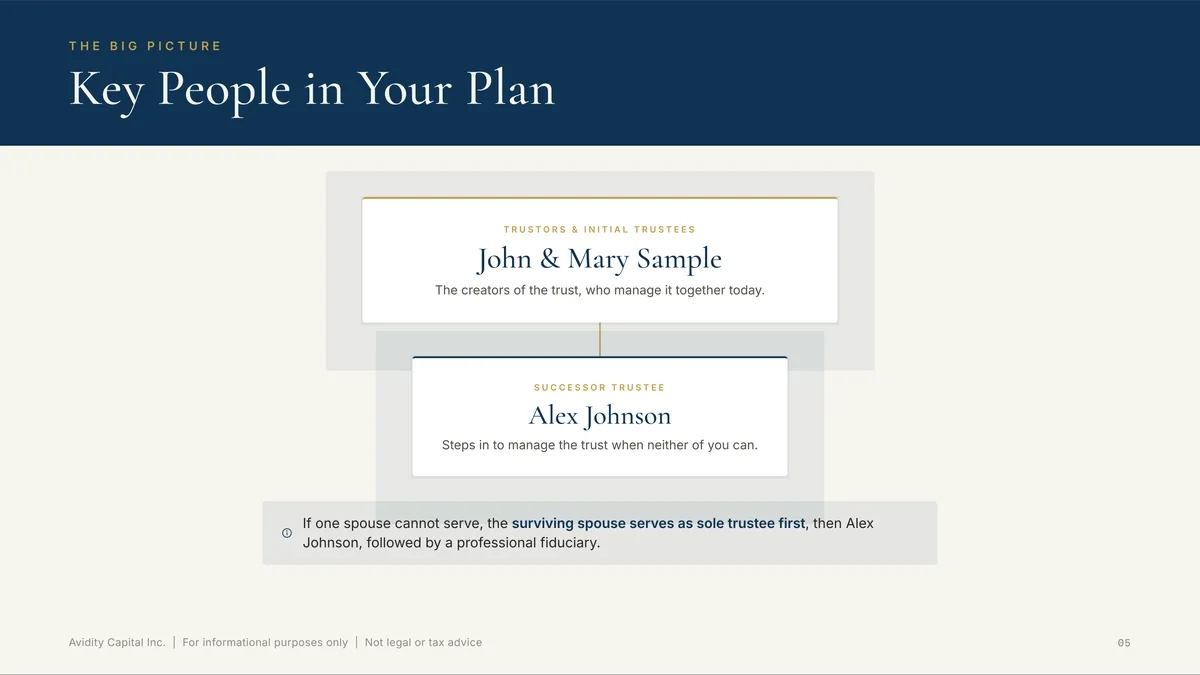
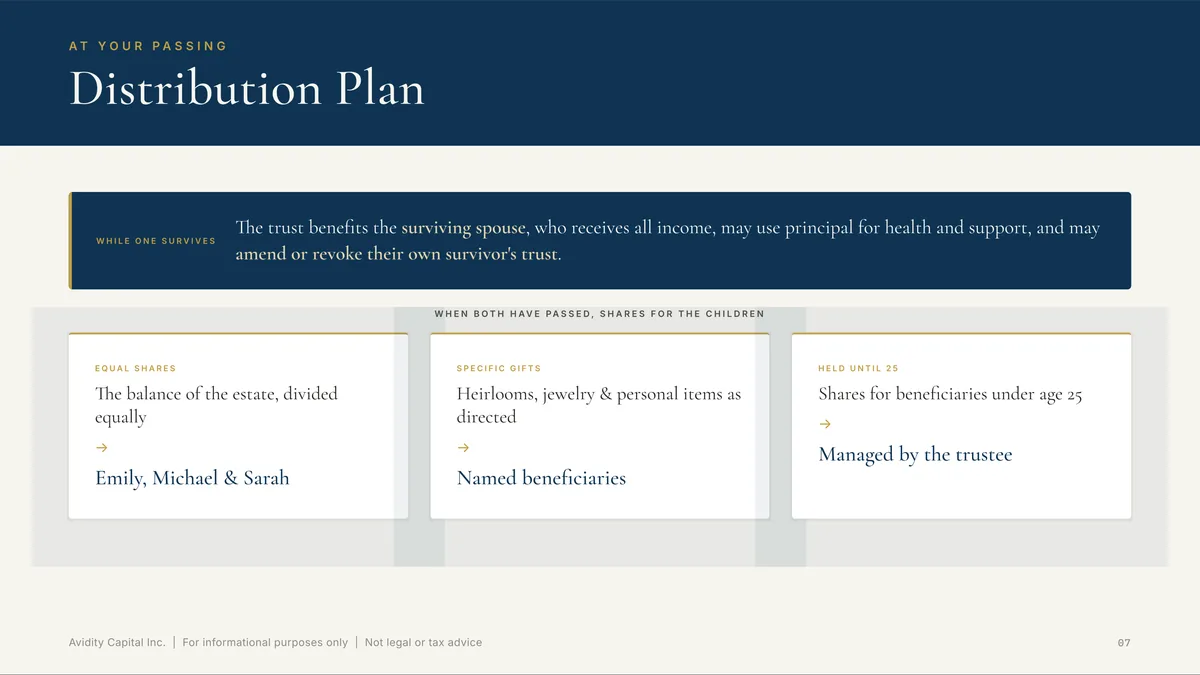
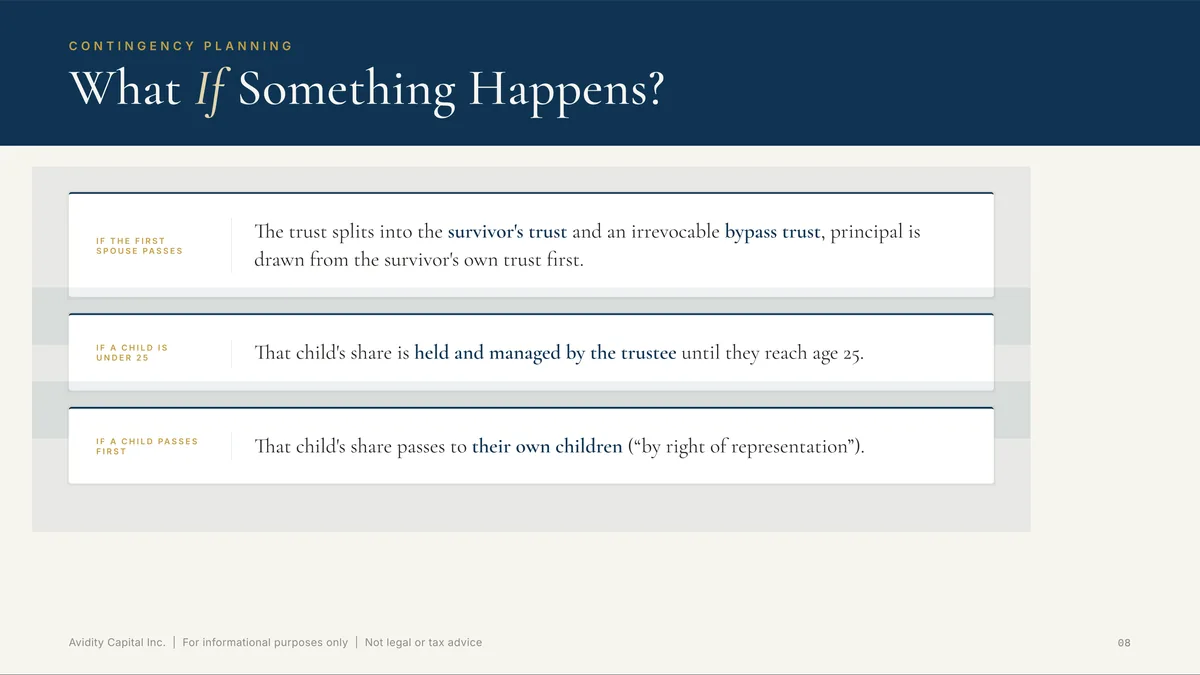
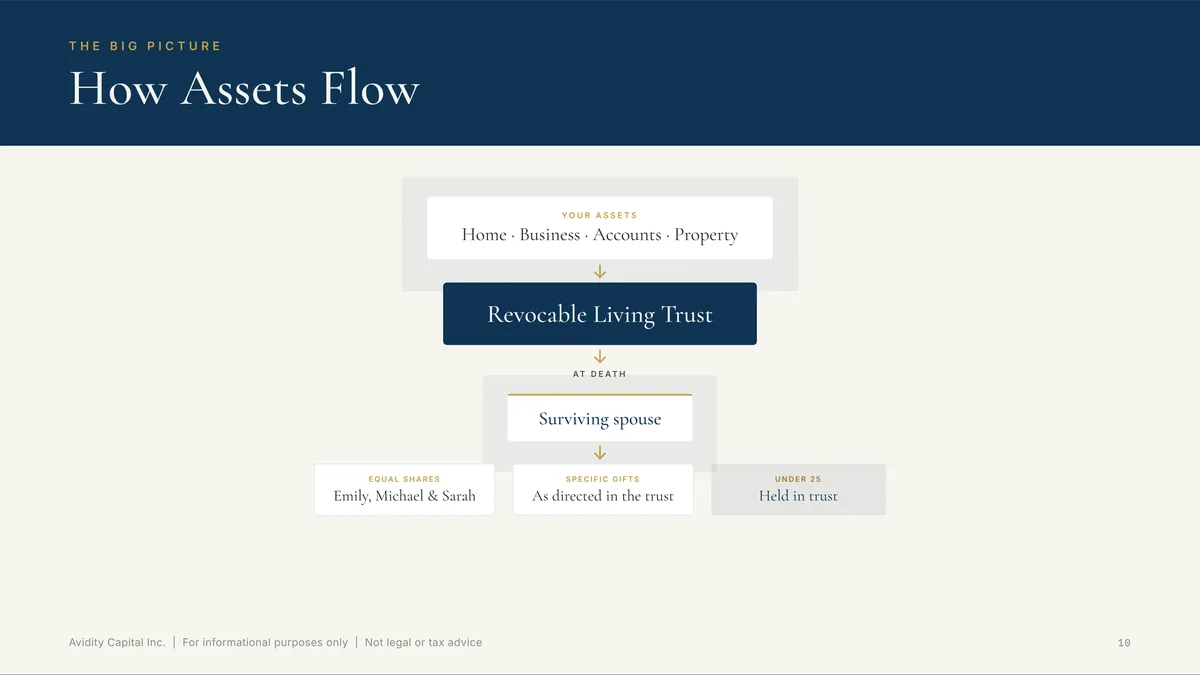
Read the whole sample. Fourteen pages, prepared for a fictional family. The advisory team page uses placeholders where a real family's attorney and trustee would appear.
Sample Estate Plan Review (PDF, 3.8 MB)How it works alongside your attorney
The review is not a substitute for counsel; it is the preparation for counsel. The sequence, for a family already in our engagement, usually runs like this:
- You gather the documents, we read them. Trust, amendments, will, powers, directive, deeds, assignments, beneficiary forms. We read them together as one plan and draft the review.
- The open items become the agenda. Everything the documents left unclear or missing is written down as a question. That list goes to the attorney meeting, and we go with you, so the questions get asked and the answers get captured.
- The attorney answers, and amends if you decide to. Whether anything should change is a legal judgment and a family decision. We take no position on it. If documents are amended, the review is updated to match.
- The review is printed and the plan is explained. To you first. Then, if you choose, to the children and the people named in key roles, in a meeting we help you run.
The action steps on the last pages carry the work forward. The first one is almost always the same: confirm that the home, the land, the accounts, and the entity interests are actually titled in the name of the trust, because the trust only governs what has been transferred into it. The Attorney General's guidance makes the same point, asking families to make sure assets have been "funded" into the trust properly. The others are to align retirement account and life insurance beneficiary designations with the plan, to make sure the trustee, agents, and attorney know where the documents are, and to decide when the plan gets looked at next.
We receive nothing from any attorney, and the family chooses its own counsel. If you already have an estate attorney, we work with them. If you need one, we introduce candidates and you decide.
Who it is for, and what it costs
The Second Look is part of our comprehensive planning engagement, Legacy Land Advisory, for families with a net worth above roughly $3 million. Most of them hold farmland, a family business, or both, and most of them are in Kings, Tulare, and Fresno counties: Hanford, where our office is, Lemoore, Visalia, Tulare, Fresno, and the towns between. We meet in person or by video. More on who we serve and where.
The $3 million line is the same working number we use when we encourage families to price a professional trustee. Around that level, estates stop being a collection of accounts and become a collection of moving parts: entities, real property, leases, tax elections. The plan gets longer, the number of people named in it grows, and the cost of someone misunderstanding it goes up.
There is no separate charge for the review. It is included in the flat annual fee published on our services and fees page, alongside the planning around any land transaction, the reinvestment strategy, and the coordination of the attorney, CPA, and other professionals. Families who choose the version of the engagement with two facilitated family summits each year often use the review as the agenda for the first one. We do not offer the review as a standalone service.
Legacy Land Advisory
Not sure what your own trust says?
Start with a confidential, no-cost first conversation. Bring nothing but the questions you have never been able to answer about your plan. We will tell you plainly whether the engagement is a fit, and if it is not, where to go instead.
Working with a family as their attorney or CPA? Start here.
Common Questions
The Estate Plan Review:
What Families Ask
Can someone look over our family trust and tell us what it says?
Yes, with a distinction that matters. Avidity Capital reads every document in a client family's estate plan and restates what those documents say in plain English, as a printed Estate Plan Review. We report what the trust says; we do not judge whether it is right or whether it complies with the law. That second question belongs to an estate planning attorney, and part of our work is making that attorney meeting more productive by arriving with a written list of exactly what needs confirming.
Is the Estate Plan Review a legal review?
No. It is an educational summary of existing documents. It does not interpret the law, does not state what the law requires, and does not recommend trust structures. Every page carries the notice that it is not legal or tax advice. The California Attorney General's consumer guidance says an attorney qualified in estate planning should review an existing trust or will; we agree, and the review is built to feed that process rather than replace it.
What documents do you need from us?
The revocable living trust and every restatement or amendment to it, the pour-over will, the durable financial power of attorney, the advance health care directive, the certification or abstract of trust, the recorded deeds for real property, any assignments of business or LLC interests to the trust, and current beneficiary designation forms for retirement accounts and life insurance. Most families have between four and ten documents. Missing items are noted in the review rather than guessed at.
What happens if the documents conflict or something is missing?
When documents conflict, the most recent restatement or amendment controls, and the review notes which document and date we relied on. Anything unclear, such as an ambiguous successor order, a blank beneficiary, a stale date, or a possible missing amendment, is listed as an item for the family and their attorney to confirm. Nothing is filled in by assumption.
Can we share the review with our children and our trustee?
That is what it is for. The review is printed in a large presentation format and written so that an adult child, a successor trustee, or a health care agent can read it without a law degree and understand what role they hold, when it begins, and what the plan asks of them. Families who choose the engagement version with two facilitated family summits per year often use the review as the agenda for the first one.
What does the Estate Plan Review cost, and can we hire you just for that?
The review is part of the Legacy Land Advisory comprehensive planning engagement, which is billed as a flat annual fee published on our services and fees page. There is no separate charge for the review, and we receive nothing from any attorney. We do not offer the review as a standalone service; it is built for families, generally with a net worth above roughly $3 million, who are working with us on the whole picture.
How often should an estate plan be looked at again?
No California statute sets a schedule, so we do not quote one. The last action step in every review is to decide when the plan gets looked at next, and we suggest tying that to events rather than a calendar: a marriage, divorce, birth, or death in the family; buying or selling farmland or another major asset; a change in who should serve as trustee or agent; moving property into or out of an LLC, partnership, or trust; and changes in property tax or estate tax rules that affect how land passes to children. Our page on Prop 19 and the family farm covers one of those rules. For the full list of review triggers and the lawyer-versus-adviser split, see how often to update a trust in California.
Important Disclosures
This page is educational and describes a service Avidity Capital Inc. provides to its advisory clients. It is not legal, tax, or investment advice. The Estate Plan Review summarizes a family's existing documents in plain language; it is not a legal interpretation of those documents, does not evaluate their quality or validity, and does not replace review by qualified legal counsel. Avidity Capital Inc. does not practice law or draft estate planning documents. The sample review linked on this page was prepared for a fictional family; every name, address, and figure in it is illustrative.
Regulatory Disclosure: Avidity Capital Inc. is a California state-registered investment adviser (CRD# 312745). Registration does not imply a certain level of skill or training. For firm background information, visit adviserinfo.sec.gov/firm/summary/312745.
No Commission Disclosure: Avidity Capital Inc. is compensated solely by advisory fees paid directly by clients. The firm does not receive commissions, referral fees, or revenue-sharing payments from sponsors, issuers, product providers, attorneys, or trustees.